

For several weeks, my posts have been about the gaps CTOsphere addresses in agentic development. Today, I want to give a fuller view of the platform and how the pieces work together. If something here fits a problem you’re working through, please reach out to set up a meeting. We can assess what makes sense for your organization and scope a custom implementation.

The premise is straightforward. Giving an agent a ticket is only part of delivering software. The team still needs to define the work, provide the reasoning behind its standards, review the result, and understand what happened when something goes wrong. Those responsibilities grow as more agents start working across more repositories.
CTOsphere is the platform I’m building through O’Side Systems to support that operating model. It connects the knowledge agents need with the controls teams need to run them, then uses evidence from the work to improve the next decision. It is delivered through hands-on assessment and implementation, with a scope that fits the organization.
More generated code creates more responsibility
An agent can produce a plausible change without understanding why a service boundary exists. Even after a build passes, the reviewer may have to reconstruct the assumptions that shaped the implementation. A dashboard can show activity while saying very little about whether the work was worth its cost.
With 10 agents working concurrently, the gaps compound. Engineers reconstruct context while reviewers chase missing evidence. Platform teams spend time investigating differences between runners. Leaders try to turn usage data into a defensible investment decision.
I’ve spent enough time working on platforms to care about what happens after the demonstration. A useful system has to support the people who operate it and the people who are accountable for its results. CTOsphere brings those responsibilities into the development workflow.
Four capabilities, with clear ownership
CTOsphere has four independently adoptable capabilities. Each owns a different part of the problem, and each has a defined relationship with the others.
| Capability | What it provides | What that gives the team |
|---|---|---|
| Decision context | Versioned decisions, standards, runbooks, and measurable expectations served to agents | A record of why the system works the way it does and which guidance a run received |
| Agent orchestration | Issue-driven execution, isolated workspaces, review and repair workflows, and run evidence | A managed path from a ticket to a pull request ready for human review |
| Fleet configuration | An authoritative registry, repeatable configuration, drift detection, and coordinated operations | A way to operate multiple orchestrators without maintaining each one by hand |
| Observability as code | Checked metric definitions, outcome evaluation, cost accounting, and proposed assessments | Evidence that helps the team judge delivery and improve its own expectations |
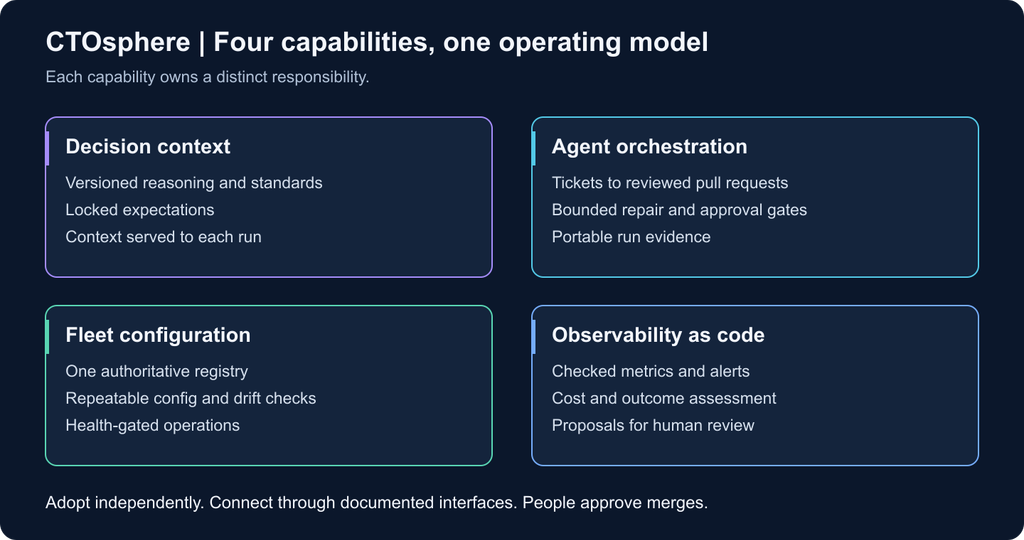
Together, these capabilities connect intent to execution and execution to learning. Individually, they can address a specific constraint without requiring a full platform rollout.
Decision context gives agents the reasoning behind the code
A repository contains the implementation. The reasoning often lives in chat conversations or someone’s memory. When an agent misses that reasoning, it can make a locally sensible change that conflicts with a decision the team already made.
Decision context puts that knowledge into versioned files reviewed alongside the work. Records can represent architecture decisions, methods, prompts, runbooks, and services. They can identify which paths they govern, so an agent working on billing can receive the decisions relevant to billing.
The expectation attached to a decision is locked when the decision is recorded. Consider an illustrative service change with an expectation of keeping p95 latency below 200 milliseconds over a 90-day window. Locking that expectation preserves the original commitment. Later assessment has something specific to compare against, even if the team’s memory of the decision has changed.
Agents receive relevant records through a read-only interface using the Model Context Protocol, or MCP. The run records which record IDs were served. That doesn’t prove an agent interpreted every instruction correctly. It gives reviewers a concrete account of the context it received.
Coverage checks expose areas without governing decisions. They also flag broken references and inconsistent relationships between records. Task-specific context resolution applies declared precedence when guidance overlaps. Existing standards can be extracted and organized into the same structure, reducing the work required to get started.
The files remain readable outside the platform. The organization’s reasoning belongs to the organization.
Agent orchestration carries work through review and repair
Sinfonia provides CTOsphere‘s agent orchestration. It watches an issue tracker and starts work when a ticket enters a configured state. Each issue gets an isolated workspace, and the workflow defines how the agent should work within it.
A repository’s workflow contract is versioned with its code. Teams can route different states to different agents or models, using integrations that include Linear and Jira, Claude Code and Codex, and model APIs. Execution adapters extend the same job contract to CI workflows and Docker runners, as well as other agent frameworks. The delivery process also supports GitHub and GitLab workflows, including enterprise hosting options.
The work moves through planning, implementation, independent machine review, and rework. A failing CI check can send the change back for another attempt. Review comments can trigger rework too, as can conflicts that appear while the change waits for review. Retries and phase budgets bound that loop, with approval checkpoints when the workflow needs a person’s decision.
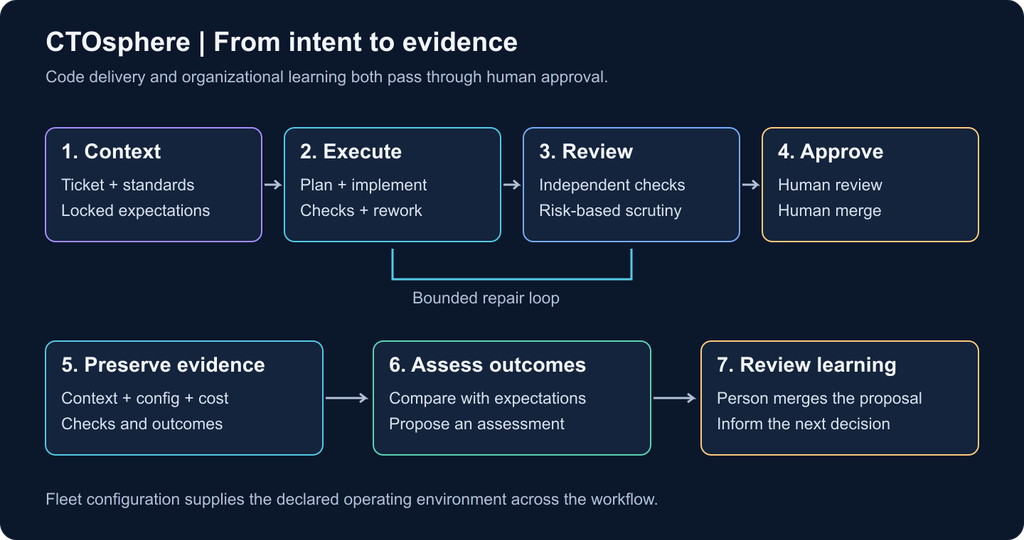
Agents never merge. Human review on protected branches remains part of the operating model. Machine review helps prepare the work and surface issues before a person spends time on it.
Operational controls cover more than the happy path. Declared environments identify the toolchain and pin images by digest. Preflight checks explain why a ticket wasn’t dispatched. Agents don’t hold tracker credentials, and fencing prevents an expired attempt from continuing as though it still owns the work. Pause controls and dispatch limits give operators ways to intervene.
Budget semantics matter here. The qualified deployment profile uses soft budgets, so I wouldn’t describe them as a guaranteed hard spending ceiling. The useful question is what the configured system detects, stops, and escalates, and how much work may already be in flight.
Every run produces a portable evidence record. It captures configuration and model identity, context served, usage and cost information, and outcomes. Evidence accompanies the pull request, giving the reviewer more to work with than a diff and an agent’s explanation.
Fleet configuration makes scale an operational decision
Running 1 orchestrator is manageable. Running several introduces configuration drift and deployment coordination across customer or team boundaries. A setting changed on one host can become a problem nobody notices until a run behaves differently.
Fleet configuration keeps an authoritative registry in version control. Configuration is rendered from that registry, and checks detect missing or manually changed output. Credential entries hold references rather than literal secrets.
Each instance pulls its own configuration with read-only credentials. It validates the configuration before applying it atomically, then confirms the loaded version and readiness. The previous valid configuration is retained for explicit recovery. Configuration synchronization doesn’t require an inbound management connection to the instance.
Provisioning and health-gated upgrades extend that model across the fleet. Operators can see drift and coordinate changes across the fleet. They can also apply capability restrictions. Emergency access is explicit and audited.
The interface targets conformant orchestrators, so this capability can manage an implementation other than Sinfonia. That matters for teams with existing investments they want to retain.
There is also a precise limit to the repeatability claim: generated configuration is byte-reproducible. Agent output remains variable. Rehydrating a run helps reconstruct its conditions; it doesn’t promise identical code on the next attempt.
Observability should change the next decision
Observability as code handles 2 related jobs: keeping the instruments accurate and evaluating the work they describe.
A canonical metric taxonomy defines names and units along with the labels attached to each metric. Dashboard and alert configurations are checked against it, as are collector configurations. When a metric changes, a broken reference can fail a check before an empty panel quietly becomes someone’s view of production.
The second job is calibration. Run evidence supports comparisons between predicted and observed cost and duration, along with cost per accepted change. Model and subagent usage can be examined in the context of delivered work. Unknown cost stays unknown. Calibration excludes synthetic runs and withholds statistics when the sample is too small.
That discipline makes the numbers more useful. A cheap attempt that repeatedly needs repair may be expensive by the time a change is accepted. A more expensive model may be justified for a particular workflow. The evidence gives the team a way to evaluate those tradeoffs.
Behavioral evaluations version scenarios alongside prompts and apply a declared bar at merge. Replay scoring helps compare outcomes, including runs produced outside Sinfonia. Review routing uses paths and labels to apply the appropriate scrutiny while preserving the human merge boundary.
The resulting assessment returns as a proposed change to the knowledge records. A person reviews and merges it. Observations inform the next decision without silently rewriting what the organization previously expected.
A change can carry evidence the customer can verify
For teams delivering software to another organization, the evidence needs to travel with the work. The customer may need to evaluate it without access to the vendor’s dashboards or operating environment.
CTOsphere supports signed attestations for checks and delivery milestones. Portable evidence packs accompany expectation records that customers can verify. A customer-signed verification profile defines the checks applied by an open-source verifier in the customer’s own CI environment.
For example, 1 delivery can include the agreed expectation, the relevant run evidence, and signed statements about the checks performed. The receiving team can verify that package against its selected profile. A signature establishes provenance and integrity; the checks and their scope determine what the evidence demonstrates.
That provides a concrete basis for a vendor review. It also makes the definition of done something both sides can inspect.
Adoption can start with the constraint you already have
The capabilities communicate through documented interfaces, including MCP, OpenTelemetry, versioned evidence formats, and pull requests. They don’t require direct code dependencies on one another. Sinfonia can operate without decision context. Observability can work with existing telemetry, while fleet configuration can manage other conformant orchestrators.
A team struggling to preserve architectural reasoning might start with decision context. A team already using agents but manually chasing CI failures might start with orchestration. An organization operating several runners may need fleet control first.
The commercial model reflects that flexibility. Sinfonia has an Apache 2.0 orchestration core, with its public community distribution coming soon. Enterprise runtime capabilities and the other CTOsphere products are provided under license through implementation engagements.
I’m using Sinfonia to work on the suite’s own tickets, with agents opening pull requests and people merging them. That gives me a direct feedback loop on the operating model. A customer’s pilot still has to establish value in that customer’s environment.
Start with one team and measurable delivery
CTOsphere engagements begin with a readiness assessment. We look at repositories, CI, review practices, and where agents already fit into the work. The assessment produces a written report, including when the right next step is to improve the foundations first.
From there, a fixed-scope pilot covers 1 team and a defined set of repositories. Success is measured in merged pull requests. We can also examine review effort, rework, lead time, and cost per accepted change against a baseline agreed for that engagement.
The initial qualified profile is self-hosted, with a separate runtime and bridge per trust boundary, Linear and Claude Code, and operator access behind the customer’s identity controls. Broader integration support gives us options; the assessment establishes which configuration fits and what needs validation.
A successful pilot provides the basis for wider rollout and ongoing operation. It also tells us which controls are useful and which practices need to change before more work is automated.
If your team is producing more agent-written code but spending too much effort reconstructing context or proving that the work is ready, please reach out. We can assess the gap and define a CTOsphere implementation around it. The goal is a development system your team can operate with confidence and improve as it grows.