
A redesign, a retirement, and what comes next
I haven’t posted in a while, but I have been busy. Now seems like the right time for an update.
If you’ve been here before, you’ll notice the site looks different. The redesign is the visible part of a larger re-scope of the business plan and the product roadmap.
What isn’t changing: I’m still taking fractional CTO work with small and mid-sized businesses. If you want to talk through your situation and where I might be able to help, I’m happy to meet.
What is changing is the product offering. I’ve tightened it considerably.
Wyrd Builder
The most interesting thing I’ve been building is Wyrd Builder, a creative tools suite for evaluating systems with complex rules and open-ended variables.
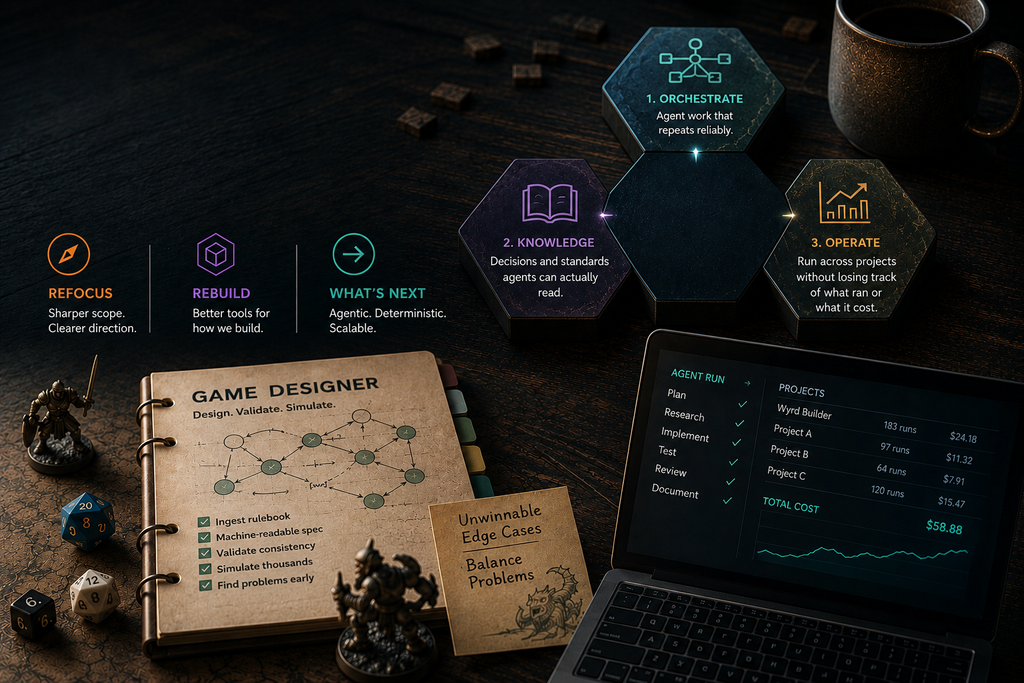
The first product out of it is Game Designer, an operating system for tabletop game design. You ingest your rulebook into a machine-readable specification, configure it to match how your game actually works, and validate it for internal consistency. That validation step is what unlocks the feature I care most about: thousands of simulations in seconds. You find the unwinnable edge cases and the balance problems before you pay for a single physical component.
I’ll be at PAX West in Seattle talking with indie designers and other people in the hobby about their process and where it hurts. Game Designer is in private alpha. Sign up and I’ll see about getting you added.

Retiring CTOsphere in its first form
New products are fun. Pivoting on what you learned is can be equally satisfying.
About eight months ago I announced CTOsphere, a tool for technical leaders and non-technical founders that combined curated best practices with a RAG-based index of their own decisions and documents. The goal was to make agentic processes more deterministic and decisions traceable and measurable.
I’m retiring that version.
I never marketed it past word of mouth, and I never got a strong signal that it worked as an all-inclusive tool. For a long stretch I was the only user. Additionally, the pace of commercial LLM development also undercut the case for an independent web tool doing that work, or a CLI, or an MCP server, or an API.
Plenty of it survived. Pieces of CTOsphere are running in production systems today, which told me which parts were worth keeping.
What CTOsphere becomes
CTOsphere is a suite now, not a single product.
The core of one piece gets open-sourced soon (stay tuned!) The rest are hard-won, battle-tested solutions I’ll deploy and support as custom implementations: agentic development patterns I’ve been building and refining for the better part of a year.
Broadly, they cover three things:
- Orchestrating agent work so it repeats reliably.
- Keeping architectural decisions and standards somewhere agents can actually read them.
- Running all of it across more than one project without losing track of what ran or what it cost.
The point is to make agentic software development more deterministic, testable, and scalable for small and mid-sized development shops. None of this is theoretical. I’ve been using it to build Wyrd Builder and other unreleased applications, and the quality and predictability are noticeably better than LLM-assisted coding on its own.
If your team is working out how agents fit into how you build, that’s the conversation I want to have. As always, if you’re running a startup or a small-to-medium business and you’re trying to make sense of all this agentic development stuff, reach out and let’s talk.